
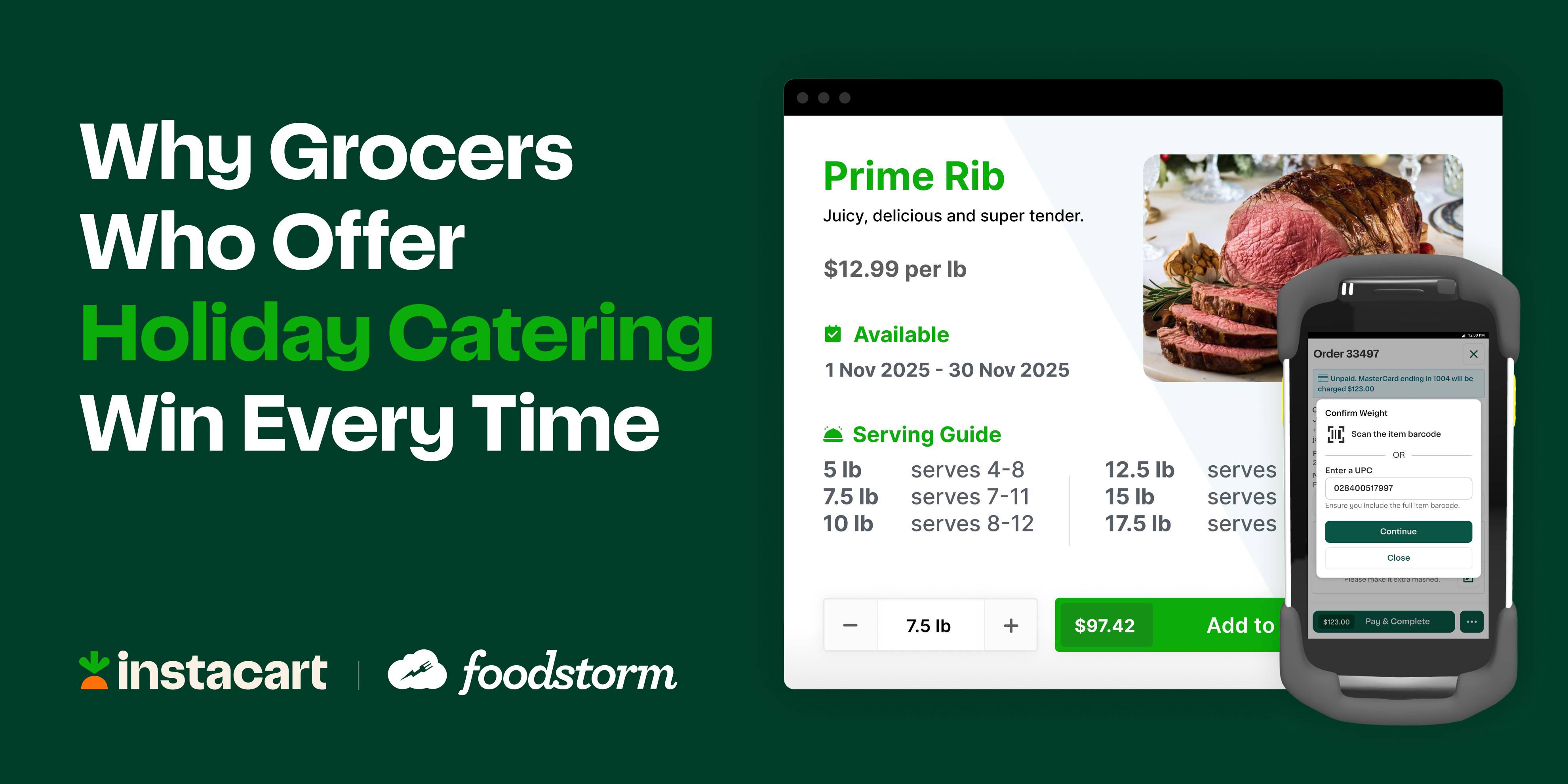
Every November, something predictable happens across America: families, offices, and event planners scramble to figure out who's handling the food. And every year, the grocers who are ready for that moment with structured catering programs, digital ordering, and reliable fulfillment capture an outsized share of the most valuable shopping season of the year.
The grocers who aren't ready? They watch that revenue walk out the door and into a competitor's parking lot.
Holiday catering isn't a niche add-on. For grocery retailers positioned to execute it well, it's one of the highest-margin, highest-loyalty revenue channels in the entire store calendar. And the data backs it up.
Let's start with the scale.
📊 The U.S. catering service market, including holiday catering, is experiencing significant growth and is projected to reach USD$100 billion by 2030. [IBISWorld]
📊 The average catering order can be 4-6x the average in-store grocery basket size. [FoodStorm internal data / Earnest data]
What makes November and December uniquely powerful isn't just volume, it's purchase intent. Catering customers arrive with a specific, high-value need. They're not browsing; they're buying. And when a grocer makes that purchase experience seamless, the transaction size reflects it.
The holiday window is short. But the revenue impact and the customer relationships built during it last well beyond December.
Here's what the grocery industry sometimes misses about catering: it isn't just a transaction. It's a trust event.
When a customer orders a catering spread from your store for Thanksgiving dinner or a company holiday party, they are betting their reputation on yours. Get it right, and you've earned a customer who will return not just for catering, but across their entire grocery routine.
📊 Speciality and fresh-format grocers grow foot traffic between 4.7%-7.7% vs 3.1% for traditional grocers, and customers are willing to travel 7+ miles farther to these grocers. [Placer.ai]
“After implementing FoodStorm for catering, Roche Bros. saw a 315% increase in catering orders and 310% increase in catering revenue, and the customer ordering functionality has encouraged repeat purchases." - Roche Bros. Supermarkets
This isn't anecdotal. Catering is a relationship accelerant. It builds the kind of goodwill that drives cart sizes, loyalty program enrollment, and word-of-mouth referrals all from a single successful experience.
The good news? The competitive landscape for grocery catering is far less crowded than it should be.
Despite the clear revenue opportunity, a significant portion of grocery retailers still lack a structured, digital catering program. Many rely on manual processes — phone orders, paper forms, spreadsheets — that cap their capacity, create fulfillment errors, and make scaling impossible during peak demand.
📊 66% of grocery shoppers want to see a prepared foods menu online, and 62% want the ability to order in advance. [FMI]
📊 97% of grocery executives say scaling their perimeter businesses is either “extremely important” or “very important” over the next 1-5 years, yet most stores still rely on in-store associates as the primary ordering method across all counters. [FoodStorm/GroceryDive]
The retailers who are investing in modern catering infrastructure — digital ordering, streamlined operations, proactive customer outreach — are building a capability that competitors simply can't replicate overnight. That's a moat. And the holiday season is when that moat matters most.
One of the most consistent patterns across high-performing grocery catering programs is that the best results happen long before the first order arrives.
Holiday catering done well requires proactive setup: menus finalized and priced correctly by early fall, operational workflows tested and documented, customer-facing promotions live well ahead of the November rush, and staff trained on fulfillment protocols.
📊 71% of Thanksgiving orders in 2026 for FoodStorm retailers were placed between October 20-November 20. [FoodStorm internal data]
Grocers who wait until October to build their catering program are already behind. The retailers winning in holiday catering treat it like a campaign with timelines, checklists, and clear milestones, not a Q4 reaction.
If the business case is this clear, why is holiday catering still an untapped opportunity for so many grocery retailers?
The answer, consistently, is operational complexity.
Managing a catering program at scale across multiple departments, store locations, and order types is genuinely hard. Coordinating the kitchen, the front counter, the online ordering system, and the customer communication is a multi-layered challenge that breaks down fast under holiday pressure.
“Before FoodStorm, our team had to write down orders on a piece of paper, then transfer the orders to a spreadsheet. FoodStorm has streamlined and centralized our workflow significantly.” - Fareway Grocery
This is the gap between retailers who view catering as a "nice to have" and those treating it as a strategic growth channel. The difference isn't intent, it's infrastructure.
The grocery retailers who consistently outperform during the holiday season have something in common: they started preparing months before.
They've moved catering online. They've built menus that reflect what customers actually want in November and December. They've trained their teams. And they've started promoting because holiday catering customers make decisions early.
“Treat it like a true operational program, not just another department. It takes strong leadership, consistent execution, and systems that support the complexity behind the scenes. As demand grows for prepared meals, catering, and special orders, having the right technology and the operational processes to support that technology becomes increasingly important.” - Harmon’s Grocery
FoodStorm was built for exactly this: giving grocery retailers the tools to manage holiday catering programs at scale, from digital ordering to production management to customer communication, so that the complexity doesn't become a ceiling on growth.
Holiday catering rewards the retailers who are ready. And being ready isn't about having the best kitchen or the biggest staff, it's about having the right systems, the right plan, and the right promotional strategy in place before the rush arrives.
The question isn't whether your customers want holiday catering. They do.
The question is whether your store is the one they can count on to deliver it.
If you're a grocery retailer evaluating your holiday catering program for 2026, we'd love to talk. Learn how FoodStorm helps grocers like you build and scale catering programs that perform when it matters most. Contact us today.

